CrewAI Icon

CrewAI Freemium

The Multi-Agent AI Orchestration Platform for Automating Complex Business Workflows

What is CrewAI?

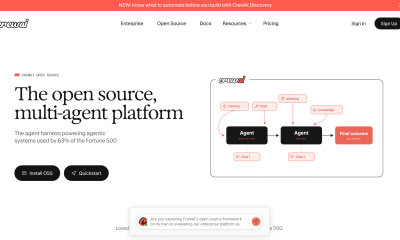
CrewAI is a multi-agent AI orchestration platform that enables organizations to build teams of specialized AI agents that collaborate on complex workflows. Each agent in a “crew” has a defined role (Researcher, Writer, Analyst, Reviewer), specific goals, and access to designated tools (web search, database queries, API calls). Agents communicate with each other through structured delegation and feedback loops, handing off task segments and reviewing each other’s output — mirroring how human teams actually work. Unlike single-agent AI tools that attempt everything with one model call, CrewAI decomposes complex tasks into specialized sub-tasks, assigns each to the best-suited agent, and orchestrates the handoffs and quality checks that produce superior results. The framework is open-source for developers who want full customization, while the CrewAI Enterprise platform provides a managed UI for business teams who want to deploy agent crews without writing code.

Product Features

  • Agent Definition with Roles and Goals: Define each agent’s role, backstory, goal, and personality — creating specialized team members like “Senior Market Researcher” who prioritizes data accuracy, or “Creative Copywriter” who focuses on engagement and brand voice
  • Tool Assignment per Agent: Give each agent specific tools — web search for researchers, file writing for content creators, calculator for analysts — ensuring agents can execute their assigned tasks with real capabilities, not just text generation
  • Task Decomposition & Sequential/Parallel Execution: Define tasks with descriptions, expected outputs, and dependencies. CrewAI orchestrates execution sequentially (Task B depends on Task A’s output) or in parallel (Tasks A and C run simultaneously), optimizing workflow efficiency
  • Inter-Agent Delegation & Review: Agents can delegate subtasks to other agents and request reviews from peers — a Researcher can ask an Analyst to validate findings before passing them to the Writer, creating built-in quality control
  • Human Input Gates: Insert human approval checkpoints into workflows — pause execution at critical decision points, review agent output, approve or redirect before the crew continues. This keeps humans in control of high-stakes processes
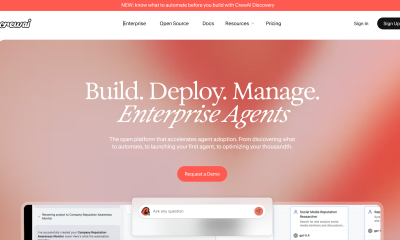
  • CrewAI Enterprise UI: Business users can define crews, tasks, and agents through a visual interface without writing Python — drag-and-drop agent configuration, tool selection, and workflow design make multi-agent automation accessible to non-technical teams

Product Highlights

  • Team-of-Agents Architecture: CrewAI’s multi-agent approach produces better results than single-agent systems on complex tasks — specialization + collaboration + review loops consistently outperform one model trying to do everything
  • Open-Source Core with Enterprise Option: Developers get full code-level customization through the open-source framework; business teams get managed deployment through CrewAI Enterprise — both paths lead to the same powerful multi-agent engine
  • Human-in-the-Loop by Design: Unlike fully autonomous agent systems that run unchecked, CrewAI embeds human approval gates at configurable points — maintaining oversight and accountability in business-critical workflows
  • Real Tool Integration: Agents don’t just generate text — they search the web, query databases, call APIs, write files, and send emails. This tool-using capability makes CrewAI agents genuinely productive, not just conversational

Use Cases

  • Content Marketing Teams: Deploy a crew of Researcher → Strategist → Writer → Editor agents to produce weekly blog content — the Researcher gathers data, the Strategist defines angles, the Writer drafts articles, and the Editor polishes for brand voice and SEO compliance
  • Financial Analysts: Build a crew of Data Gatherer → Quantitative Analyst → Risk Assessor → Report Writer to produce daily market briefings — each agent contributes specialized analysis, and the final output combines quantitative rigor with readable narrative
  • Customer Support Operations: Create a crew of Triage Agent → Specialist Agent → Quality Reviewer to handle complex support tickets — the Triage Agent categorizes and routes, the Specialist Agent resolves the issue using knowledge base tools, and the Quality Reviewer verifies the response before sending
  • Product Development Teams: Define a crew of Market Researcher → Feature Analyst → UX Writer → Documentation Agent to produce product requirement documents — each agent contributes domain-specific expertise, producing comprehensive specs faster than any single analyst
  • Legal & Compliance Departments: Deploy a crew of Regulation Researcher → Compliance Checker → Document Writer → Legal Reviewer to generate compliance reports — the researcher identifies relevant regulations, the checker maps them to business practices, the writer drafts the report, and the reviewer ensures legal accuracy